International events are being held from 20 to 30 June 2026 at the Ruse University Angel Kanchev in the city of Ruse, Republic of Bulgaria, within the framework of the Erasmus+ Programme. These events aim to promote effective teaching methods and innovative pedagogical practices among university faculty members, facilitate the exchange of experience, and strengthen scientific cooperation.
The international events are attended by faculty members of the State Energy Institute of Turkmenistan — Gadam Akmyradov, Ayna Nurmyradova and Oguljan Akmyradova — who are participating as part of an official academic mission. The main objectives of the visit are to study contemporary pedagogical approaches in higher education, exchange experience in innovative teaching methods, explore advanced practices in the implementation of digital educational technologies, and expand international scientific cooperation.
Located on the banks of the Danube River in northern Bulgaria, Ruse University Angel Kanchev is one of the country’s leading multidisciplinary higher education institutions. Established in 1945, it is recognized as the first higher technical educational institution founded outside the national capital, Sofia. Today, the university serves as a major centre for education and research in the regions of Ruse, Razgrad, Silistra, and Vidin. Its structure comprises eight faculties, several research centres, and regional branches. The university provides high-quality education in engineering, information technologies, natural sciences, economics, law, healthcare, and pedagogy. Moreover, it implements more than 200 cooperation agreements under the Erasmus+ programme and maintains effective partnerships with higher education institutions across Europe, Asia, and the Americas. The university’s extensive international engagement demonstrates its successful integration into the European education and research area.
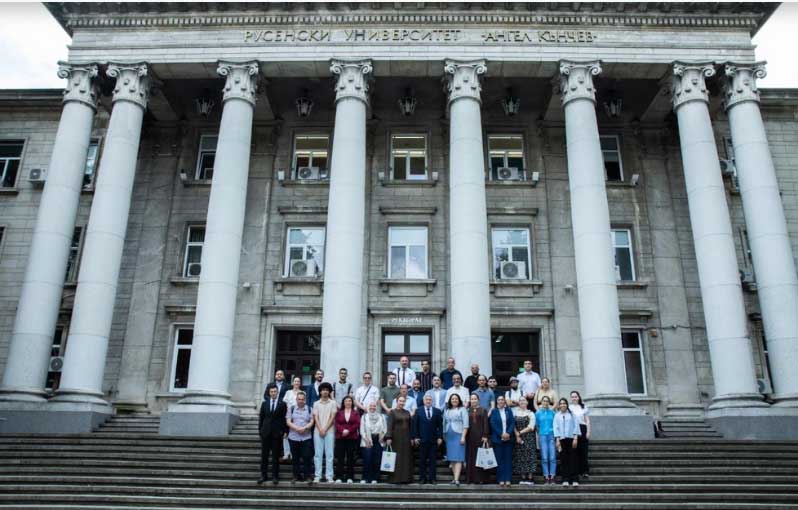
On the first day of the visit, an opening ceremony was held with the participation of representatives from thirteen higher education institutions from ten countries, namely Albania, Algeria, Egypt, France, Jordan, Montenegro, Morocco, Tunisia, Turkmenistan, and Türkiye. During the event, participants delivered presentations highlighting their institutions’ achievements in education, science, and innovation, as well as their experiences in international cooperation and ongoing projects.
During the meetings, participants are discussing issues related to the extensive integration of digital technologies into the educational process, the potential of artificial intelligence in education, blended and digital learning models, interactive teaching methods, improving the effectiveness of research activities, and enhancing the international competitiveness of higher education institutions.
As part of the academic visit, the international scientific conference “CompSysTech’26” (“International Conference on Computer Systems and Technologies”) is also being held, bringing together scholars, researchers, and faculty members from various countries. The conference provides a platform for comprehensive discussions on research findings related to artificial intelligence, information systems, software engineering, digital transformation, cybersecurity, cloud technologies, information and communication systems, and the advancement of computer systems.
Representatives of the State Energy Institute of Turkmenistan are actively participating in the conference by sharing their experience in the application of digital technologies in higher education, innovative pedagogical approaches, improving research efficiency, and creating modern educational environments. In addition, they are exchanging views with foreign scholars on the implementation of joint research projects, the expansion of academic mobility programmes, and the further development of scientific cooperation.
These international activities conducted within the Erasmus+ Programme provide broad opportunities for enhancing the professional qualifications of academic staff, studying advanced global educational and scientific practices, introducing innovative technologies into the national education system, and further strengthening international cooperation.