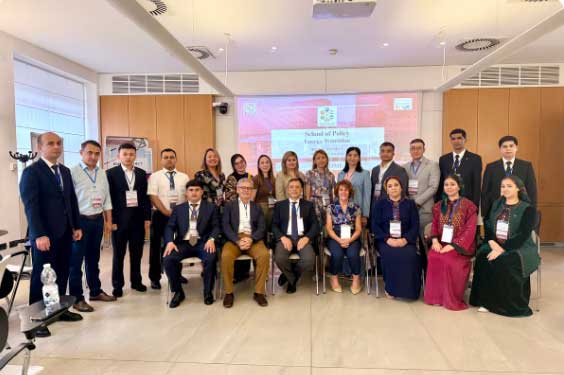
The international educational and practical program “School of Energy Transition Policy” was held at the University of Milano-Bicocca from July 13 to 17, 2026. The project was implemented as part of the BRIDGE (Building Sustainable Institutional Dialogue) initiative with the support of the Italian Ministry of Foreign Affairs, as well as within the priorities of the Italy-Central Asia and C5+1 dialogue platforms, according to the country’s International Information Center.
A delegation from the Academy of Public Administration under the President of Turkmenistan, including faculty, students, and graduate students, actively participated in the program. The forum provided an effective platform for analyzing global energy trends, regulatory frameworks for the electric power industry, decarbonization processes, and the transition to a sustainable green economy.
The Milan program combined in-depth academic training with practical exposure to cutting-edge infrastructure. Participants explored the experience of Italian regulators and major companies such as ARERA, Sogesid, Terna, and WeBuild in the areas of government regulation, incentives for renewable energy development, and the construction of complex hydraulic structures.
Delegates were particularly impressed by a visit to the digital control center of A2A (Ricevitrice Nord Milano), where the city’s energy supply is managed in real time. Also of particular interest were lectures on the implementation of artificial intelligence in smart grid management and the application of the WEFE Nexus intersectoral approach, which integrates water, energy, food, and the environment.
A key component of the internship was the direct interaction between young civil servants and specialists from all Central Asian countries. This fruitful exchange of national practices allowed for the development of a new vision for common regional challenges.
The program concluded with a ceremony awarding international certificates. The knowledge gained in digitalization, flexible public administration, and cross-sectoral planning will serve as a solid foundation for the further development of green energy and public administration in Turkmenistan.