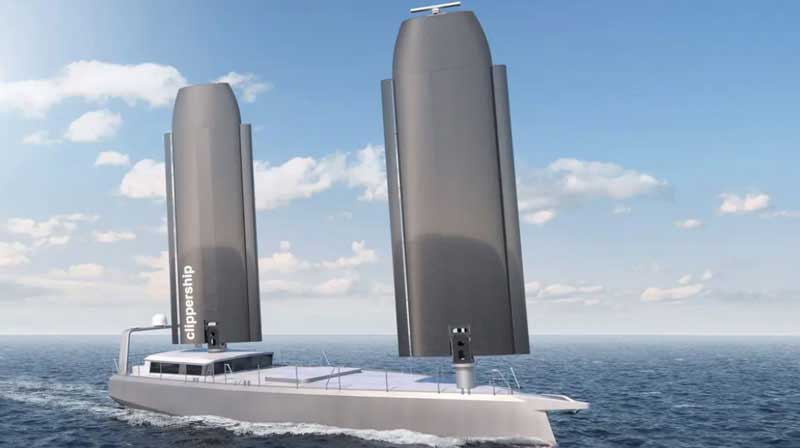



Clippership, an American company specializing in marine robotics, is completing the development of an unusual 24-meter-long unmanned cargo vessel powered by wind. To achieve this, the vessel will be equipped with two folding, rigid carbon composite wings, which promise to be twice as efficient as traditional fabric sails. The vessel is designed for transatlantic crossings with minimal human intervention.
The world’s first shipping trials of cargo ships with wing-sails, which generate propulsion using the laws of aerodynamics rather than simply the influence of air masses, took place two years ago. Wing-sails have proven effective and will be adopted as a way to save fuel without completely abandoning internal combustion engines. The Clippership project proposes a different approach: relying entirely on the wind as the propulsion force for the unmanned cargo vessel.
The company is developing the vessel design in collaboration with naval architecture specialists Dykstra Naval Architects and Glosten. A contract has been signed with the Dutch shipyard KM Yachtbuilders for the vessel’s keel-laying and construction. Relevant maritime authorities have approved the project. The vessel will fly the Maltese flag. Launch is expected in late 2026, after which comprehensive sea trials will begin, including a crossing of the Atlantic Ocean.
It is worth noting that this will be a relatively small cargo vessel, apparently designed for the delivery of special cargo. The hold is designed to accommodate 75 Euro pallets in a protected, climate-controlled space.
The stated goal of the project is to significantly reduce emissions from maritime transport through the use of wind energy, as well as to improve the efficiency and reliability of autonomous vessels. This is a step toward sustainable logistics, especially for smaller cargo volumes, where traditional container ships are less efficient.