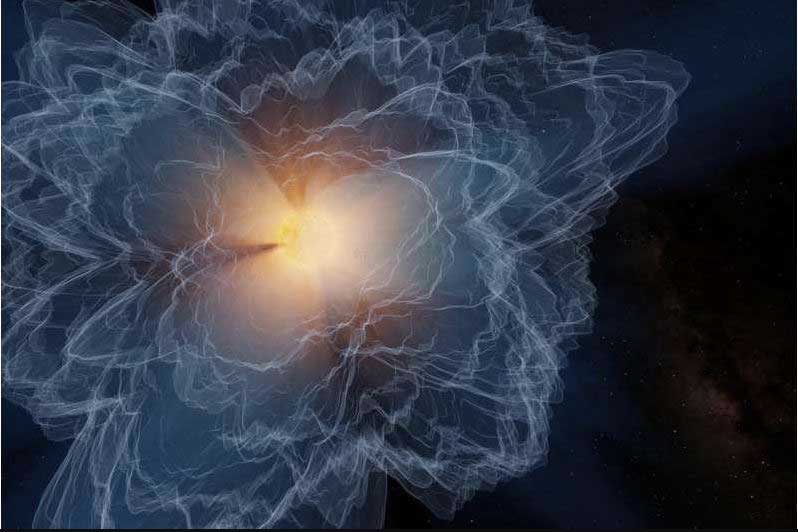



Astronomers from the Harvard-Smithsonian Center for Astrophysics (USA) have produced the first continuous two-dimensional maps of the outer boundary of the Sun’s atmosphere. This variable boundary, known as the Alfvén surface, marks the region where the solar wind overcomes the star’s magnetic pull and escapes it forever. To create the maps, the scientists used data collected by NASA’s Parker Solar Probe, as well as remote sensing. The study showed that as solar activity increases, this boundary becomes larger, and its structure becomes more complex and distinct. The work was published in The Astrophysical Journal Letters.
The Alfvén surface is the de facto edge of the solar atmosphere. Once crossed, matter cannot return to the Sun. Understanding how this boundary changes is important for studying the impact of solar activity on Earth and the entire Solar System. Previously, scientists assumed that the boundary dynamically changes over the 11-year solar cycle, but were unable to confirm this with observations. Now, by combining the maps with measurements taken by the Parker probe at close range, the researchers have been able to directly verify these changes.
The SWEAP instrument onboard the Parker probe, which plunged deep into the solar atmosphere, collected the data. This allowed them to precisely determine the location of the boundary and track its transformations. As lead author Sam Badman noted, scientists now have a precise map for navigating the solar corona.
It also helps correlate changes at the boundary with processes occurring closer to the solar surface. The results obtained can improve solar wind and space weather models, which are important for predicting their impact on technology and life on Earth. In the future, the team plans to continue observations during solar minimum to study the full evolutionary cycle of the boundary.