


The global coffee market continues to grow, but consumption patterns for this aromatic liquid vary dramatically across the globe. Northern European countries, driven by long-standing coffee traditions and high incomes, confidently lead in per capita consumption.
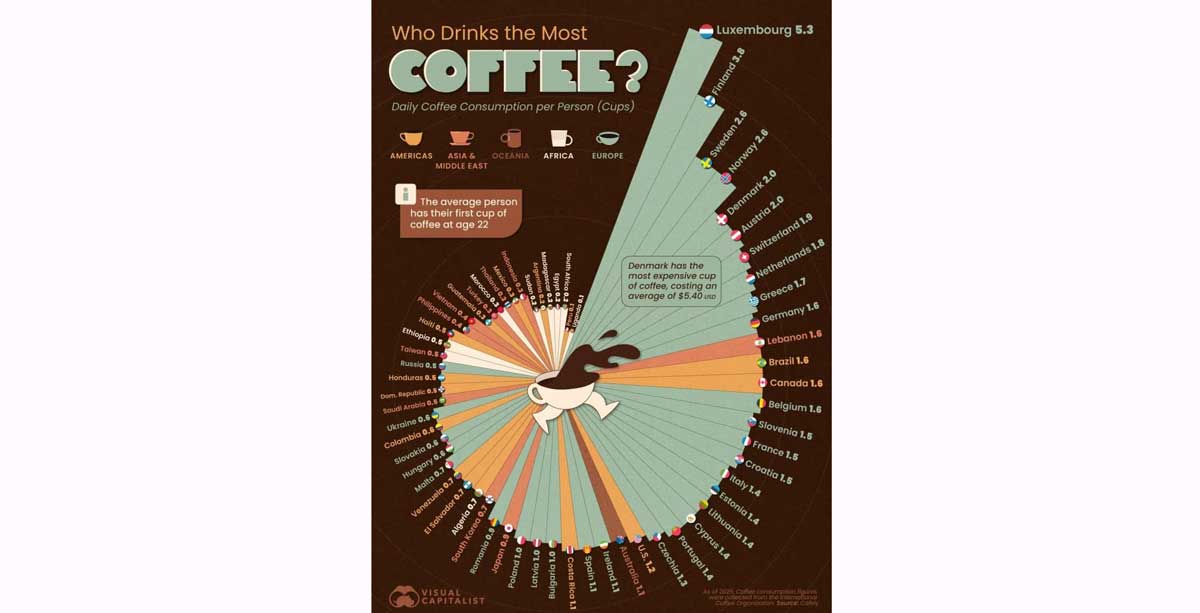
A new infographic, based on data from Cafely, ranks 65 countries by daily coffee consumption per capita in 2025, dramatically demonstrating the differences in drinking habits around the world.
Northern Europe remains the global center of coffee addiction. Luxembourg tops the global ranking with 5.31 cups per day per capita—significantly outpacing larger economies.
Luxembourg’s high ranking is due to the presence of a large number of “cross-border” workers—people who work in the country but live abroad. Nearly half of all workers (47%) live abroad, and their daily coffee consumption is included in the Grand Duchy’s statistics.
Finland and Sweden, long known for their strong coffee cultures, follow closely behind. All ten countries at the top of the ranking are European, reflecting both historical preferences and high purchasing power.
Despite significant absolute consumption volumes, large countries such as the United States, Japan, and Brazil rank significantly lower in per capita terms.
The United States, with an average of 1.22 cups per day, ranks 24th. Japan, with its thriving coffee shop scene and canned coffee culture, drinks just under one cup per day on average. Brazil, the world’s largest coffee producer, ranks in the middle of the list, in 18th place, with 1.58 cups per day. Russia ranks 46th, with 0.5 cups of coffee per day.
Countries where tea or other beverages dominate daily habits occupy the bottom half of the ranking. India records the lowest consumption—just 0.02 cups per day, equivalent to about one cup every seven weeks. Several African and South Asian countries also show low rates, typically consuming less than 0.3 cups per day.