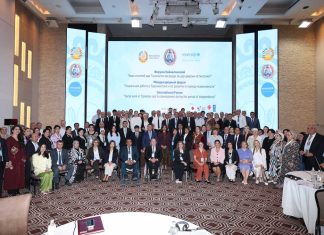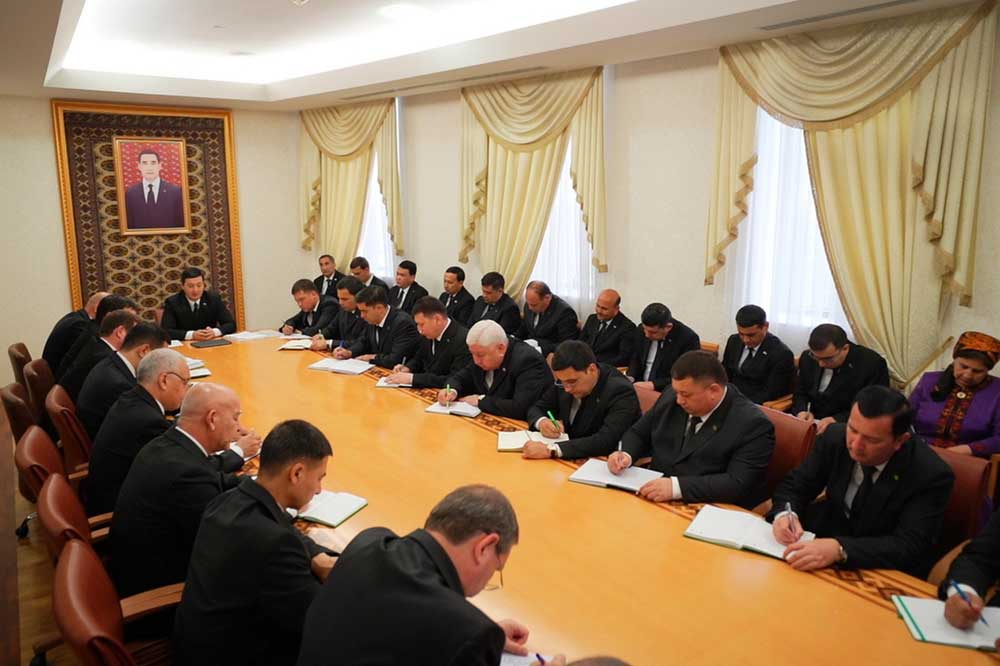
The event was held in the capital marking the opening of a new chapter in the country’s education sector. As part of the ceremony, certificates were presented to educational institutions that had successfully completed the state accreditation process. This event officially confirmed that the national education system has reached a qualitatively new level aligned with international standards.
Speaking at the ceremony, the leadership of the Ministry of Education congratulated the participants on this important achievement in the national scientific and educational sphere. It was particularly emphasized that the event represents a tangible outcome of many years of organizational, legal and institutional reforms implemented under the wise leadership of the esteemed President of Turkmenistan and consolidated into a single, coherent system.
The establishment of the national accreditation system is a logical continuation of the consistent reforms carried out in recent years. On the basis of the state educational standards adopted in 2020, curricula and programmes in more than one thousand specialities and fields of study were modernized between 2021 and 2024. In accordance with the Programme of Socio-Economic Development of the country for 2022–2028, the creation of a national accreditation system became an integral component of the state strategy.
The Regulations on State Accreditation of Educational Activities, adopted by the esteemed President Serdar Berdimuhamedov on 26 February 2024, established a unified legal framework in this area. Subsequently, the relevant criteria and plans were fully approved, and by 2026, the system had been brought into full operational readiness.
Under the first annual accreditation plan, eight educational institutions representing different levels of education applied for state accreditation. Following a comprehensive, objective and rigorous assessment conducted by expert panels, six institutions were found eligible to receive accreditation certificates.
The accredited institutions included Ashgabat Specialized Secondary School No. 74 “Bagtyýar nesiller” with Advanced Study of Foreign Languages, Secondary School No. 29, the Hydyr Deryayev Pedagogical School, the Mary region Financial and Economic Secondary Vocational School, the State Energy Institute of Turkmenistan, and the Institute of Telecommunications and Informatics of Turkmenistan.
The fact that accreditation covered not only higher education, but also general secondary and secondary vocational institutions, demonstrates the formation of a unified culture of quality throughout the country. The alignment of national educational standards with the logic of the European Higher Education Area, UNESCO classifications and the principles of the Lisbon Recognition Convention has enabled Turkmen education to speak the international “language of quality.”
This historic step serves as an institutional mechanism for safeguarding quality during a period of demographic growth in Turkmenistan, where the number of higher education students has more than doubled over the past decade. Highly qualified human capital is the country’s principal driving force on its path towards innovation, digital technologies and a knowledge-based economy.
The strengthening of the foundations of national education is also clearly reflected in the figures. While 963 articles were published in international scientific journals in 2020, this number reached 13,960 in 2025. The number of articles indexed in Scopus and Web of Science increased fortyfold, while the number of patents obtained by higher education institutions rose twenty-onefold. Furthermore, in 2025, fourteen higher education institutions of the country were included in the Times Higher Education international ranking, and twelve universities were recognized in the UI GreenMetric ranking.
A state accreditation certificate is issued for a period of five years. It is not an end, but a new commitment to the systematic and continuous enhancement of quality.
Major objectives lie ahead under the Strategy for the Development of Higher Professional Education in Turkmenistan for 2026–2052. The Strategy is aimed at developing education, science and production as an integrated ecosystem. The first accreditation cycle has laid a solid foundation for achieving these ambitious goals.