Through the activities of the “Greater Altai” Research and Education Center for Altai Studies and Turkic Studies, Altai State University continues to build international ties, bringing together researchers to study the historical and cultural heritage of Slavic and Turkic peoples. A significant step in this endeavor was the visit to Turkmenistan by Ivan Nazarov — a leading expert at the center, Chairman of the Altai Krai branch of the Russian Historical Society, member of the Civic Chamber of Altai Krai, and Director of the Institute of History and International Relations at Altai State University.
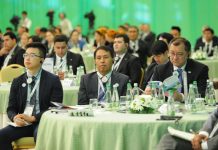
From October 10 to 12, he participated in the international scientific conference and exhibition titled “Healthcare, Education, and Sports in the Era of the Revival of the New Epoch of the Powerful State,” held in Ashgabat.
In exhibition, dozens of universities and research institutes from various countries showcased their developments and educational programs. The pavilion dedicated to Russian education drew particular interest from visitors; its presence was made possible through the initiative of the “Russian House” in Ashgabat and its director, Yulia Zaitseva. Among the Russian universities, Altai State University presented its academic programs, offering information on study conditions and additional opportunities available to international students.
The centerpiece of the conference was a plenary session chaired by Batyr Mamedov, Deputy Chairman of the Cabinet of Ministers of Turkmenistan, who oversees the sectors of science, education, healthcare, and sports. On October 11–12, the experts continued their work in various breakout sessions across Ashgabat. The Magtymguly Turkmen State University served as one of the conference organizers. Ivan Nazarov, together with Nurberdy Nurberdyev, Vice-Rector for Research at Magtymguly Turkmen State University (TSU), co-chaired the session on “Innovative Technologies in Education.” Scholars and educators from various countries shared their experiences in integrating modern technologies and artificial intelligence into the teaching of history, biology, mathematics, and physics.
In his presentation, Ivan Nazarov highlighted educational and research initiatives from Altai State University (Altai State University) conducted under the auspices of the “Greater Altai” Research and Education Center for Altaic and Turkic Studies. He invited historians, archaeologists, and ethnographers from Turkmenistan to participate in joint projects.
“The discussions during the session highlighted the high demand for interdisciplinary approaches and international cooperation in education today. We addressed the application of the STEM approach, the internationalization of higher education, and the role of artificial intelligence in professional training. It is significant that these topics bring together universities from different countries, creating tangible opportunities for collaborative projects,” noted Ivan Nazarov.
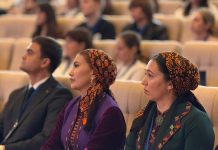
The outcomes of the session were summarized during the final plenary meeting on October 12 at the Chamber of Commerce and Industry of Turkmenistan, chaired by the country’s Minister of Health, Myratberdi Gayypov. Representatives from Georgia, Iran, Italy, Belarus, Russia, and Turkmenistan discussed the implementation of innovative technologies within higher and secondary education systems, as well as future prospects for cooperation.
An educational component also featured prominently in the visit. Ivan Nazarov delivered an open lecture to students and faculty from the Faculty of History at Magtymguly Turkmen State University, titled “Traditional Culture of the Peoples of Southern Siberia: A Focus of the ‘Greater Altai’ International Ethnographic Expedition.” A visual complement to the exhibition was the photo exhibition “Altai Preserving Traditions,” which explored the work of ethnographers on the expedition and the traditional culture of the Altai people.
Collaboration between scientists from Altai and Turkmenistan began this summer. The international ethnographic expedition “Greater Altai” included Toyly Khommyev, a lecturer at Magtymguly Turkmen State University, and Ayna Baimuradova, a doctoral student at the Institute of History and Archaeology of the Academy of Sciences of Turkmenistan.
Meetings with scientists from Turkmenistan were no less significant. At Turkmen State University, Ivan Nazarov met with the university’s leadership and staff of the Faculty of History, including Vice-Rector for Academic Affairs Durdymyrat Annayev. His colleagues discussed the university’s traditions, its development, and its current research trends. Ivan Ivanovich, in turn, discussed in detail the activities of Altai State University, the Institute of History and International Relations, and the interdisciplinary projects of the Greater Altai Scientific and Educational Center.
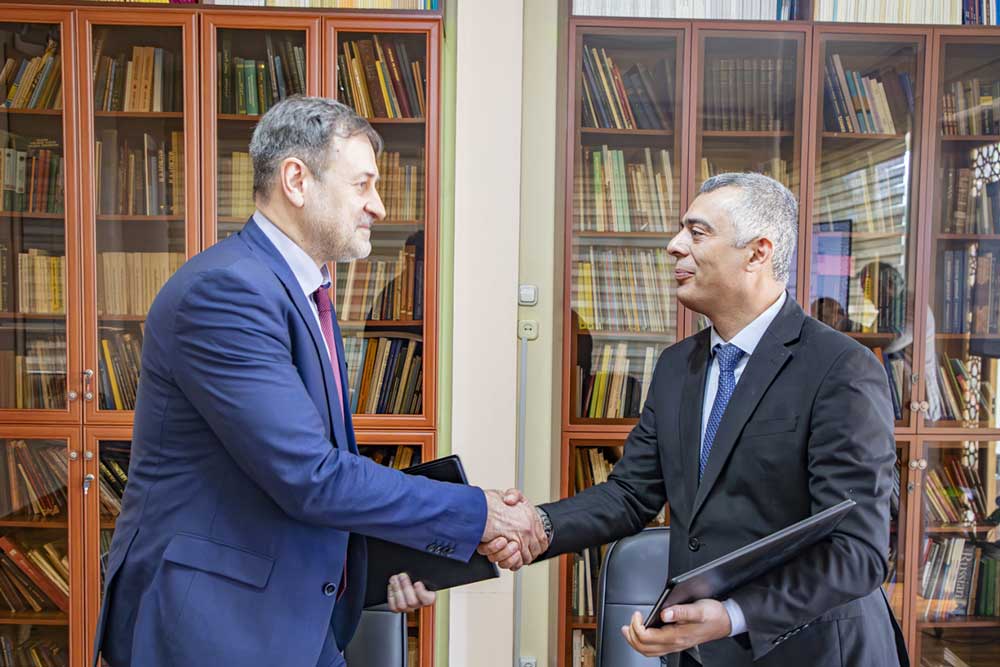
At a meeting with Orazgeldy Ovezsakhedov, Rector of the Magtymguly Turkmen State University, the parties solidified an agreement to develop cooperation between the universities in the study of the historical and cultural heritage of the Turkic peoples, implement joint research projects, participate in scientific forums, and prepare publications. Ivan Nazarov donated publications by Altai State University archaeologists and ethnographers to enrich the library collections of Turkmenistan’s leading university.