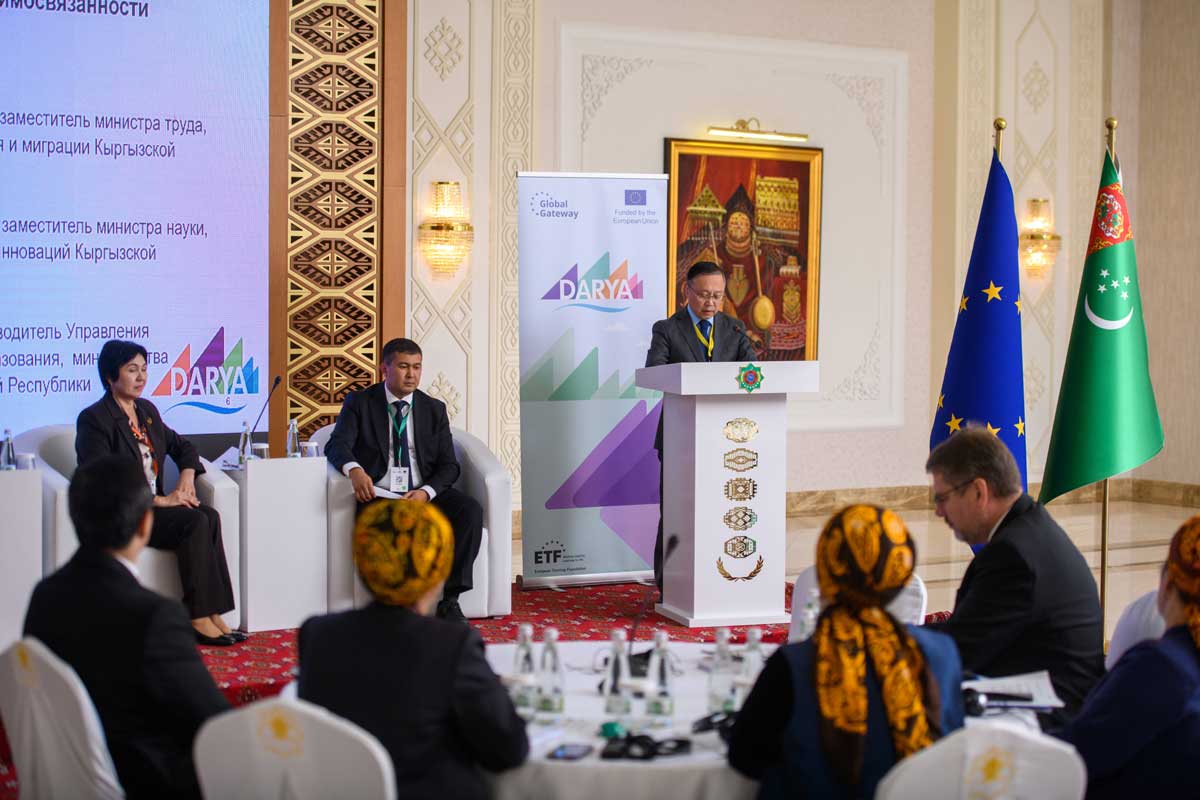
The fifth High-Level Group meeting of DARYA (Dialogue and Action for Resourceful Youth in Central Asia) closed in Ashgabat after two days of discussion on the skills needed to deliver the Trans-Caspian Transport Corridor (TCTC). Organized by the European Training Foundation (ETF) with the support of the Turkmen government, the meeting took place on 13 and 14 October at Hotel Archabil.
Deputy Ministers and senior officials for education and labour from Kazakhstan, Kyrgyzstan, Tajikistan, Turkmenistan and Uzbekistan took part. The EU Special Representative for Central Asia, Eduards Stiprais, ETF Director Pilvi Torsti joined them, and representatives of the European Commission’s Directorate-General for International Partnerships (DG INTPA).
The EU Ambassador to Turkmenistan, Luc Devigne, and the French Ambassador, Alena Grand, also attended, together with the European Bank for Reconstruction and Development (EBRD), GIZ, several local embassies, including that of Italy, and the EU Delegations in the five Central Asian countries. Industry representatives and other sectoral stakeholders completed the room.
The meeting opened on 13 October with national priorities for skills and transport connectivity, presented by the delegations. In the afternoon, DG INTPA outlined the Global Gateway investment approach and the role of skills in turning infrastructure projects into lasting results, before a panel of transport and logistics practitioners, joined by the EBRD, looked at how skills requirements in the sector are changing. The first day ended with a visit to a Secondary Vocational Construction School of the Ministry of Construction and Architecture of Turkmenistan, where participants heard from employers and graduates and saw how sectoral partnerships can shape training in practice.
On 14 October, discussions moved from evidence to regional action. An ETF study on future skills needs in residential energy efficiency in Kazakhstan and Tajikistan, based on technology and patent trend analysis, set the tone. Two thematic sessions followed, one on labour market monitoring, employer needs and emerging workforce challenges in transport and logistics, the other on new approaches to skills provision and partnerships, including a European example from the Hydrogen Valley Campus Europe ecosystem, presented by Noorderpoort in the Netherlands.
The core of the afternoon was the Regional Skills Roadmap, presented before the countries shared their positions on priority areas for cooperation. A facilitated discussion then explored regional work on skills in transport and logistics, supported by a mapping of skills providers around the port of Aktau. Participants pointed to common challenges qualifications that are hard to compare across borders, limited recognition of non-formal learning, and gaps in shared labour market data. Ideas raised for further work included a regional approach to qualifications in transport and logistics, shared methods for analysing labour market needs, and practical pilots on specific occupations. The meeting closed with the presentation of the Ashgabat Policy Messages and a ceremonial farewell.
For DARYA and its partners, the meeting built on four years of work with the five countries on qualifications, occupational profiles, labour market intelligence and teacher development. It showed how that work now connects to a concrete regional priority. The discussions also sit within the EU Strategy for Central Asia of 2019 and the objectives and investment commitments agreed in the first EU-Central Asia summit held in Samarkand in 2025. Participants considered how future cooperation could build on what DARYA has achieved, as the ETF and EU delegations in the region remain ready to continue its long-standing work on skills development in the region.
About DARYA
DARYA is a regional initiative funded by the European Union with 10 million euro and implemented by the European Training Foundation between 2022 and 2027. It supports inclusive, labour-market-relevant and sustainable skills development in Kazakhstan, Kyrgyzstan, Tajikistan, Turkmenistan and Uzbekistan, and fosters dialogue among the five countries. Previous High-Level Group meetings were held in Astana, Tashkent and Turin.