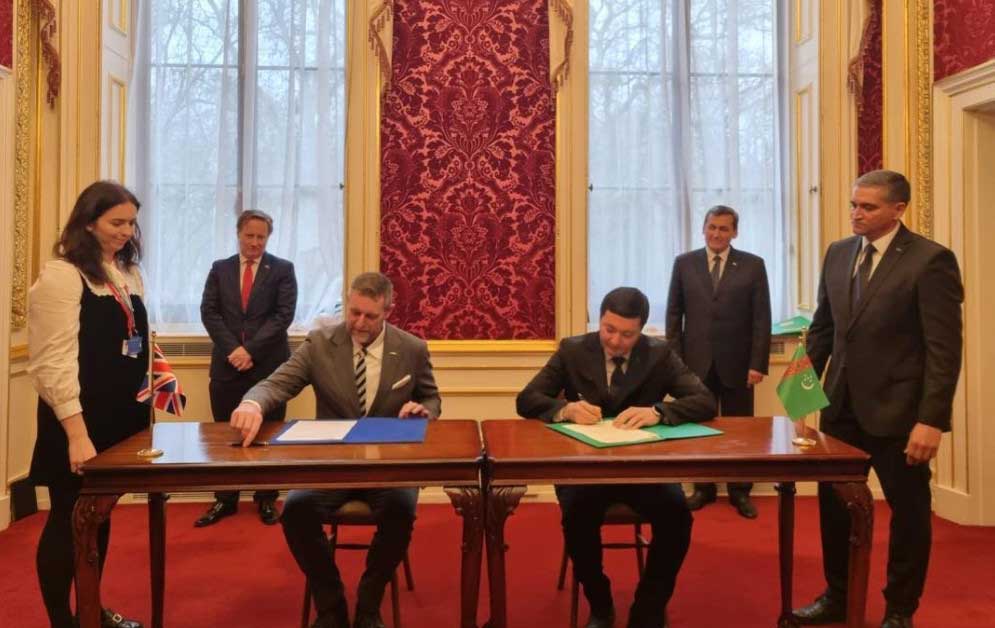



Within the framework of the consistent state policy pursued under the leadership of the esteemed President of Turkmenistan, Serdar Berdimuhamedov, Turkmenistan and the United Kingdom are bringing cooperation in education to a qualitatively new, practice-oriented level, as reported by the education.gov.tm. The signing of four cooperation documents is a logical outcome of systematic work to expand international partnerships and to establish sustainable mechanisms for adopting and implementing advanced educational practices.
It is particularly important that these agreements are directly aligned with Turkmenistan’s national education transformation priorities and correspond to the goals of: the Strategy for the Development of Higher Professional Education in Turkmenistan for 2026–2052, as well as the Implementation Program for 2026–2030 approved under it; the Concept for Improving Teaching Methodology for General Education Program in Turkmenistan up to 2028.
Four documents — four interconnected directions of practical cooperation
1) Memorandum of Understanding on cooperation in the field of skills certification between the Ministry of Education of Turkmenistan and Pearson
Cooperation with Pearson is aimed at introducing modern solutions in internationally recognized qualifications and skills certification, including the development of digital assessment formats and examination administration. The practical focus is on launching pilot mechanisms that will enable the measurement of learning outcomes, the establishment of a feedback loop for improving curricula, and the international recognition of graduates’ competencies.
2) Memorandum of Understanding on cooperation in the field of educational assessment between the Ministry of Education of Turkmenistan and AQA Global Assessment Services Ltd.
The document with AQA lays the foundation for strengthening the national system of assessment and academic measurement: building the competencies of assessment specialists, improving approaches to developing assessment materials, and increasing the transparency and comparability of results. This direction is especially relevant in the context of modernising general secondary education and moving towards more evidence-based, consistent and sustainable assessment standards, where the key task is to develop a unified, clear and reliable system for measuring the quality of learning.
3) Memorandum of Understanding between the National Institute of Education of Turkmenistan and the Norwich Institute for Language Education (NILE)
Cooperation with NILE focuses on practical professional development programmes for teachers, the advancement of teaching methodology, and the formation of sustainable professional teacher communities. The emphasis is on implementing effective models of continuous professional development (CPD) and mentoring, as well as tools to improve teaching quality, including English language teaching.
4) Memorandum of Understanding between the Turkmen National Institute of World Languages named after Dovletmammet Azadi and Nottingham Trent University
This document is aimed at developing academic and research-education cooperation with the Dovletmammet Azadi Turkmen National Institute of World Languages, including joint educational initiatives, applied training tracks, academic exchanges, collaborative projects, and strengthening the practice-oriented component of training. This direction complements the systemic objectives of modernising higher education and enhancing the international competitiveness of educational programmes.
Negotiations and next steps
Following the signing ceremony, Deputy Minister of Education of Turkmenistan A. Atayev held a series of targeted negotiations with representatives of leading UK education organisations — Pearson, AQA, NILE (Norwich Institute for Language Education) and Nottingham Trent University.
On the practical side, the parties envisage establishing joint working groups, preparing terms of reference, and developing step-by-step roadmaps (including pilots, indicators, timelines, and clearly defined responsibilities), as well as setting up mechanisms for monitoring and evaluation of implementation progress.
The signed documents confirm the readiness of both sides to pursue cooperation not in a declarative manner, but through specific joint projects aimed at improving education quality, developing human capital, and achieving Turkmenistan’s long-term strategic objectives.