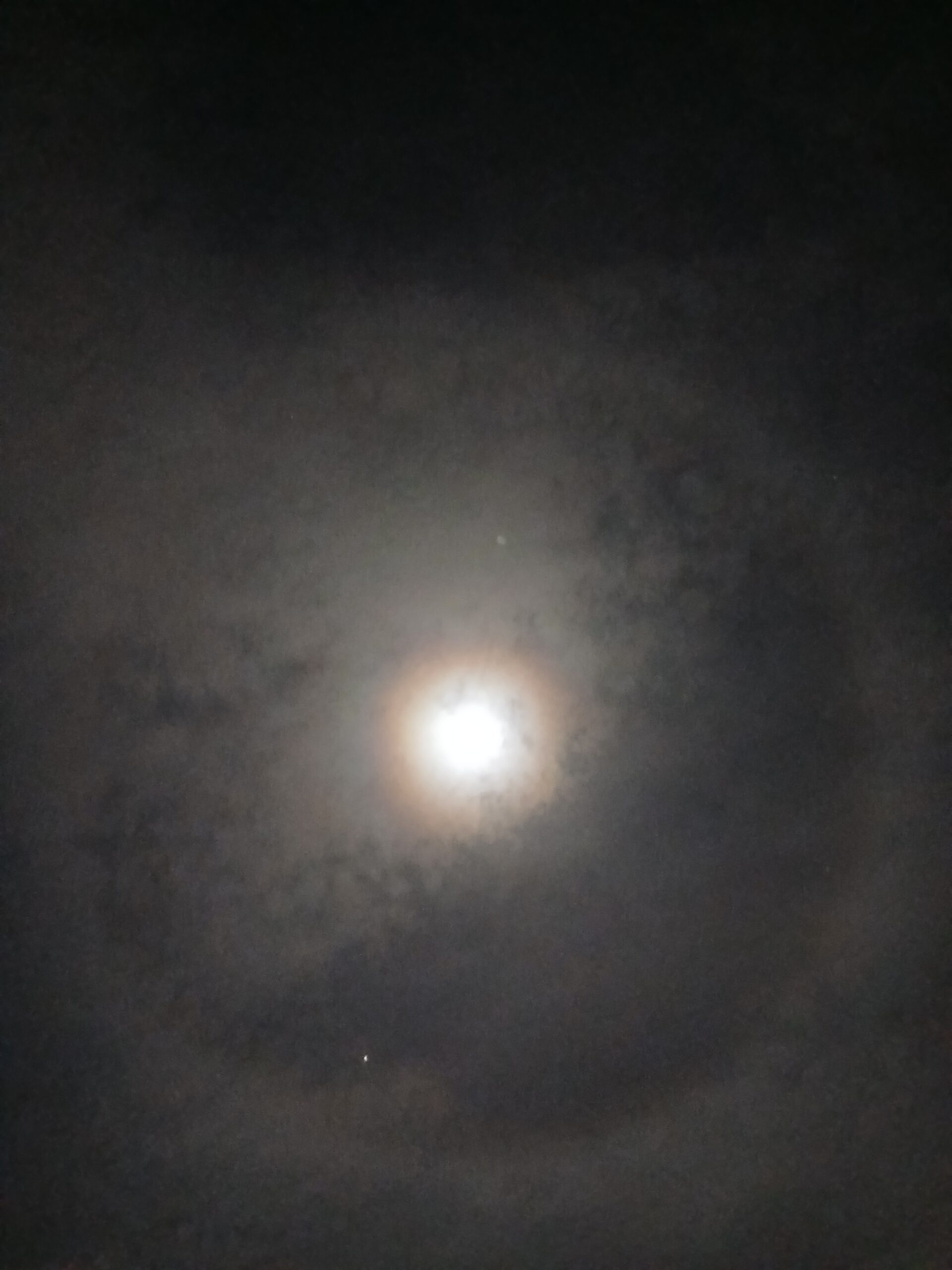



On the night of January 2, a striking natural phenomenon known as a lunar halo was witnessed by skywatchers across multiple regions. The event, which occurred during the late evening hours around 23:00, was perfectly visible to the naked eye.
The halo was particularly vivid because it occurred just as the Full Wolf Moon (the first full moon of 2026) was approaching its peak. Because the moon was also a Supermoon—positioned at its closest point to Earth (perigee)—it appeared roughly 14% larger and 30% brighter than usual. This extra luminosity acted like a powerful spotlight, making the surrounding ring of light incredibly sharp and easy to spot from various locations worldwide.
While it might look like a mystical “ring around the moon,” a lunar halo is a well-understood atmospheric optical effect:
Ice Crystals: The halo is formed when moonlight passes through hexagonal ice crystals found in high-altitude cirrus clouds (over 20,000 feet up).
The 22° Angle: As light enters these crystals, it bends (refracts) at a specific angle of 22 degrees. This creates a perfect circle with a radius that, if you held your hand out at arm’s length, would span about the width of your outstretched thumb to pinky.
The “Dark” Center: Many observers noted that the sky inside the ring appeared much darker than the sky outside it. This is because the light is redirected away from the center and concentrated into the circular band.
A “ring around the moon” is often said to predict a coming storm. This has a basis in science: the high cirrus clouds that create halos often arrive 24 to 48 hours before a warm front, which typically brings rain or snow.