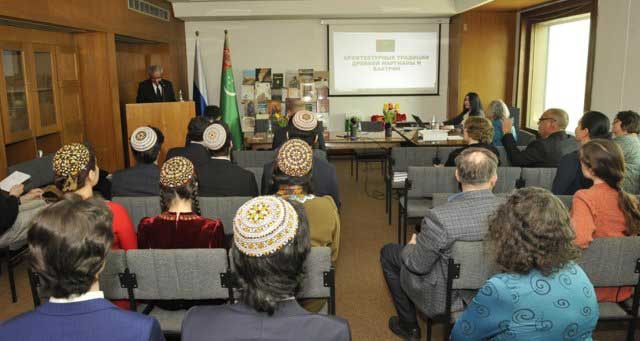



On March 25, a major international academic conference entitled “Margiana at the Crossroads of Civilizations: Intercultural Interaction in Central Asia, the Caucasus, and the Middle East – Ancient and Modern” opened at the Russian Academy of Sciences in Moscow. The event was timed to coincide with the 35th anniversary of Turkmenistan’s independence, as reported by turkmenistan.gov.tm.
The forum brought together leading academic institutions, including the Institute of Ethnology and Anthropology of the Russian Academy of Sciences, the Institute of Linguistics of the Russian Academy of Sciences, and the Institute of the History of Material Culture of the Russian Academy of Sciences, as well as relevant institutions of Turkmenistan and the country’s diplomatic mission in Russia.
The main theme of the conference was the study of intercultural ties in the historical space of Central Asia, the Caucasus, and the Middle East. Particular attention was paid to ancient Margiana—one of the key centers of civilizational development in the region, also known as the country of Margush.
The event, held in a hybrid format, brought together a wide range of participants: scholars, researchers, teachers, and experts from Turkmenistan, Russia, and several European countries, including Germany, France, Italy, and Belgium. Guests included diplomats, students, and media representatives.
A delegation from Turkmenistan arrived in Moscow specifically to participate in the conference, including representatives of government agencies responsible for cultural heritage protection, as well as staff of the Ancient Merv Historical and Cultural Reserve.
Before the plenary sessions, participants were presented with a thematic exhibition showcasing the richness of the national culture, traditions, and historical heritage of the Turkmen people.
Representatives of the diplomatic corps and the scientific community delivered welcoming remarks, emphasizing the importance of international cooperation in the study of ancient civilizations.
A key part of the program included scholarly discussions dedicated to Margiana, one of the most enigmatic cultures of the East. Several presentations touched on the Gonur-Depe archaeological complex, considered the capital of ancient Margush. It was here in 1972 that archaeologist Viktor Sarianidi made one of the region’s most significant discoveries.
The conference will continue on March 26 with thematic sessions, where participants will discuss new research and prospects for studying the region’s historical and cultural heritage.