


The hallways of the Danatar Ovezov Turkmen State Music College were filled with the atmosphere of a scientific and creative quest. Third-year students, majoring in theory, put aside their notes and textbooks to try on one of the most challenging roles—teacher. The “I Am a Future Teacher” presentation competition vividly demonstrated how Turkmenistan’s classical music school integrates digital horizons into its academic tradition.
The performers who shine on stage often overshadow the profession of musicologist, but it is the theorist who is the “key” that unlocks the door to a world of sublime harmony for the listener. Being a musicologist means more than just juggling dates and terms; it means possessing the talent of an educator, capable of making people fall in love with music from the very first lesson.
The competition participants demonstrated this through two fundamental disciplines: solfeggio and music literature.
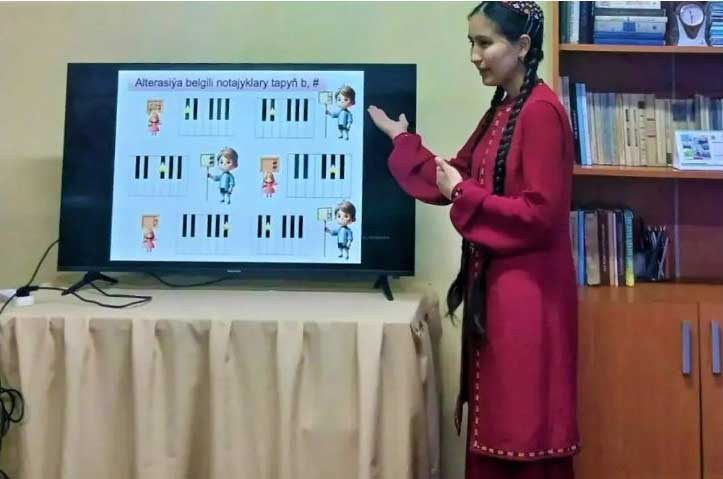
The students transformed the solfeggio section, traditionally considered one of the most rigorous disciplines, into a modern educational project. The students’ presentations resembled the interfaces of advanced applications: the study of rhythmic figures and tempos was transformed into visual digital aids. This is a new pedagogical language in which future teachers plan to communicate with the “alpha” generation, making the process of learning music engaging and understandable.
The music literature section became an in-depth multimedia study. The students did not simply analyze operatic masterpieces; they uncovered the philosophical subtext of compositional mastery. The legacy of the Bakhshis occupied a special place: in an era of powerful state support for national culture, the synthesis of academic knowledge and ancient traditions is becoming the foundation upon which a modern school is built.
Why are such competitions necessary? The answer lies in the understanding that a modern music teacher is also an IT specialist, a psychologist, and a researcher. The main goals of the competition were:
To adapt future teachers to working with high technology;
To strengthen the connection between traditional art and youth creativity;
To identify leaders capable of not simply imparting knowledge, but also “igniting” the hearts of students.
The jury noted the high level of preparation: each project was imbued with a personal approach to the profession. The winners received certificates of honor, but, as the students themselves admitted, the main result was the opportunity to feel responsible for the future of Turkmen culture.
Thanks to the implementation of educational reforms, today’s students of the D. Ovezov College are no longer just students, but practically ready-made guides into the world of beauty. Tomorrow, they will enter the classrooms of music schools to pass on the baton of love for art to a new generation, armed with knowledge, technology, and faith in their calling.