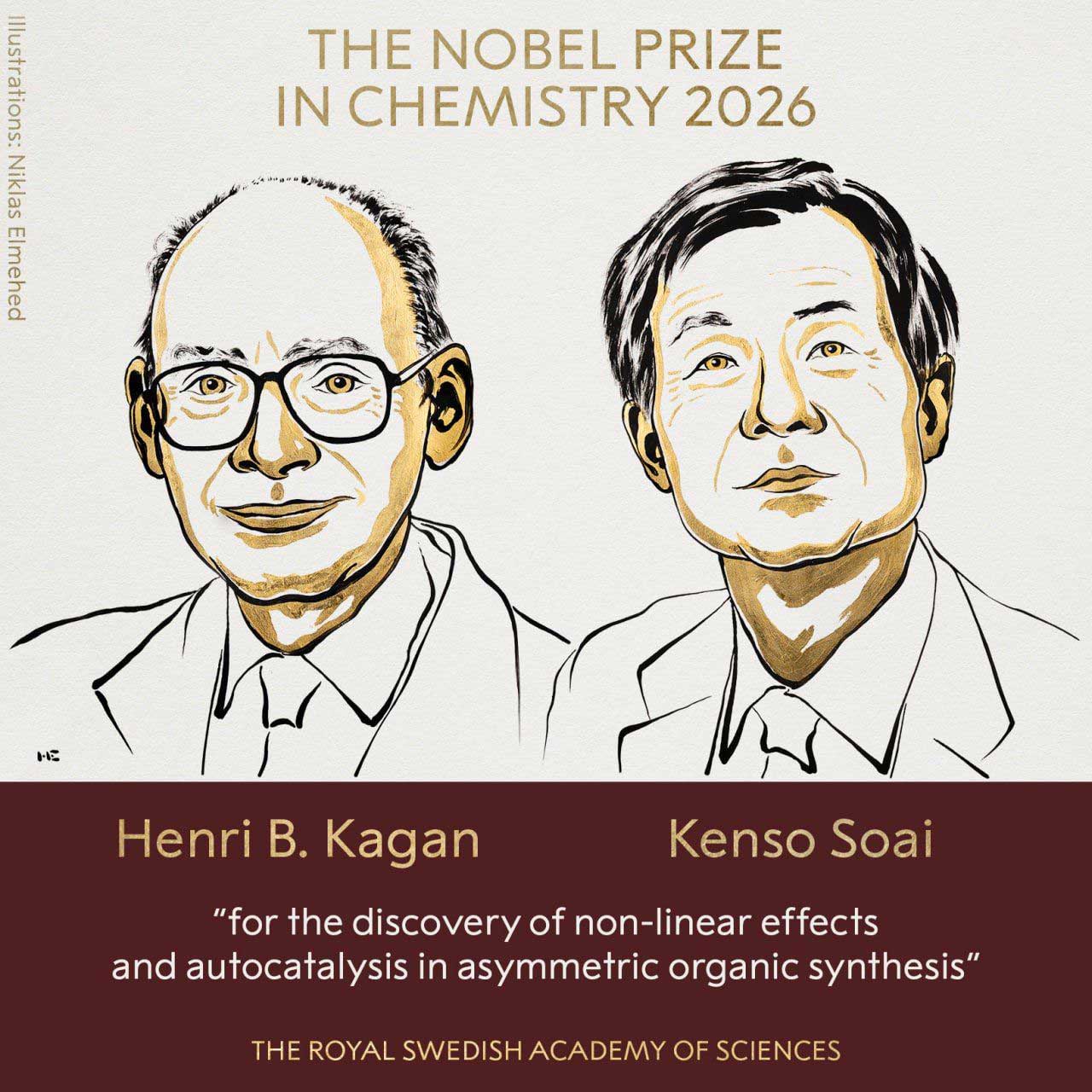
French scientist Henri B. Kagan and Japanese chemist Kenso Soai were awarded the 2026 Nobel Prize in Chemistry for discoveries in the field of asymmetric organic synthesis—specifically, the discovery of nonlinear effects and autocatalysis. This was announced on the prize’s official website.
Many molecules, such as amino acids, exist in two mirror-image forms. However, only one of these forms is found in living organisms; this characteristic is known as homochirality. This phenomenon has long intrigued chemists. As noted in the committee’s statement, Henri B. Kagan and Kenso Soai were honored for their contributions to unraveling this mystery.
In 1986, Henri Kagan laid the theoretical groundwork by discovering a new method to control chemical reactions and achieve an excess of one molecular form. Kenso Soai advanced these concepts experimentally; in 1995, he published work on a reaction with the potential to become homochiral, and in 2003, he successfully demonstrated a reaction that produced only one of the two possible forms. These discoveries by the scientists hold great practical significance for carrying out the chemical reactions essential to the development of pharmaceutical products.
A total of 117 Nobel Prizes in Chemistry were awarded between 1901 and 2025. Frederick Sanger (UK) and Barry Sharpless (USA) each received the prize twice. The youngest laureate was Frédéric Joliot-Curie, who was 35, while the oldest was John Goodenough, aged 97.
Winners in other categories will also be announced throughout October. Specifically, the laureates for Literature (October 8), Peace (October 9), and the Alfred Nobel Prize in Economic Sciences—established by the Swedish Central Bank in 1968—(October 12) will be revealed.