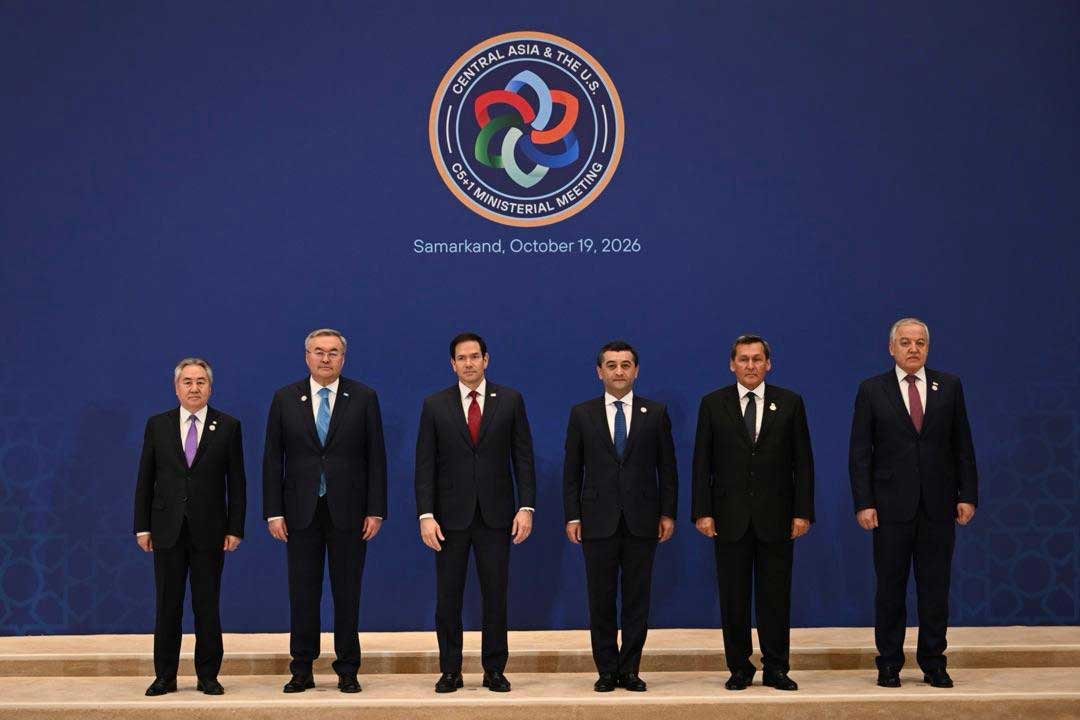
On October 19, the next meeting of the foreign ministers of the Central Asian countries and the Secretary of State of the United States of America in the C5+1 format took place in Samarkand.
During the meeting, participants discussed current issues related to further strengthening multifaceted cooperation between the countries of Central Asia and the United States, as well as prospects for developing regional cooperation in the context of contemporary international realities.
The parties reaffirmed their commitment to developing a long-term partnership based on the principles of respect for the sovereignty, independence, and territorial integrity of states, mutual trust, and consideration of common interests. Particular attention was paid to expanding political dialogue, strengthening good-neighborly relations, and promoting joint initiatives aimed at ensuring peace, stability, and sustainable development in Central Asia.
Trade, economic, and investment cooperation featured prominently on the meeting’s agenda. The parties emphasized the importance of further developing transport and logistics connectivity, including the Trans-Caspian International Transport Route, expanding mutual trade, and creating favorable conditions for stimulating corporate activity and attracting investment. They also noted the need to deepen regional economic integration, develop industrial cooperation, foster the digital economy, and implement modern technologies.
The meeting focused on prospects for cooperation in digitalization and artificial intelligence, the implementation of innovative technologies, and the development of digital infrastructure. The importance of expanding the exchange of experience and best practices, as well as attracting investment and technological solutions for joint projects in information technology, cybersecurity, automation of industrial processes, and the training of qualified personnel, was emphasized. The parties noted the importance of harnessing the potential of artificial intelligence to stimulate economic growth, improve the effectiveness of public administration, and expand regional cooperation.
Particular attention was paid to prospects for cooperation in the energy sector, the extraction and processing of natural resources, the development of value chains, and expanding opportunities for exporting finished products to international markets. Interest in sharing experiences and advanced technologies to enhance the competitiveness of the region’s economies was emphasized.
The meeting also addressed issues of strengthening regional security, including countering terrorism, organized crime, drug and arms trafficking, and human trafficking, as well as ensuring border security. The parties noted the importance of expanding cooperation in cybersecurity and critical infrastructure protection. The significance of further cooperation in nuclear safety and the peaceful use of nuclear energy was reaffirmed.
Important areas of cooperation include the preservation and promotion of historical and cultural heritage, expansion of educational and cultural exchanges, development of tourism ties, and strengthening of contacts between the peoples of Central Asia and the United States of America.
Following the meeting, a Joint Statement was adopted by the Foreign Ministers of the Central Asian countries and the United States of America in the C5+1 format, which reaffirmed their interest in further strengthening the C5+1 format as an important platform for political dialogue and practical interaction aimed at developing mutually beneficial cooperation, strengthening regional stability, and addressing pressing socioeconomic development challenges.