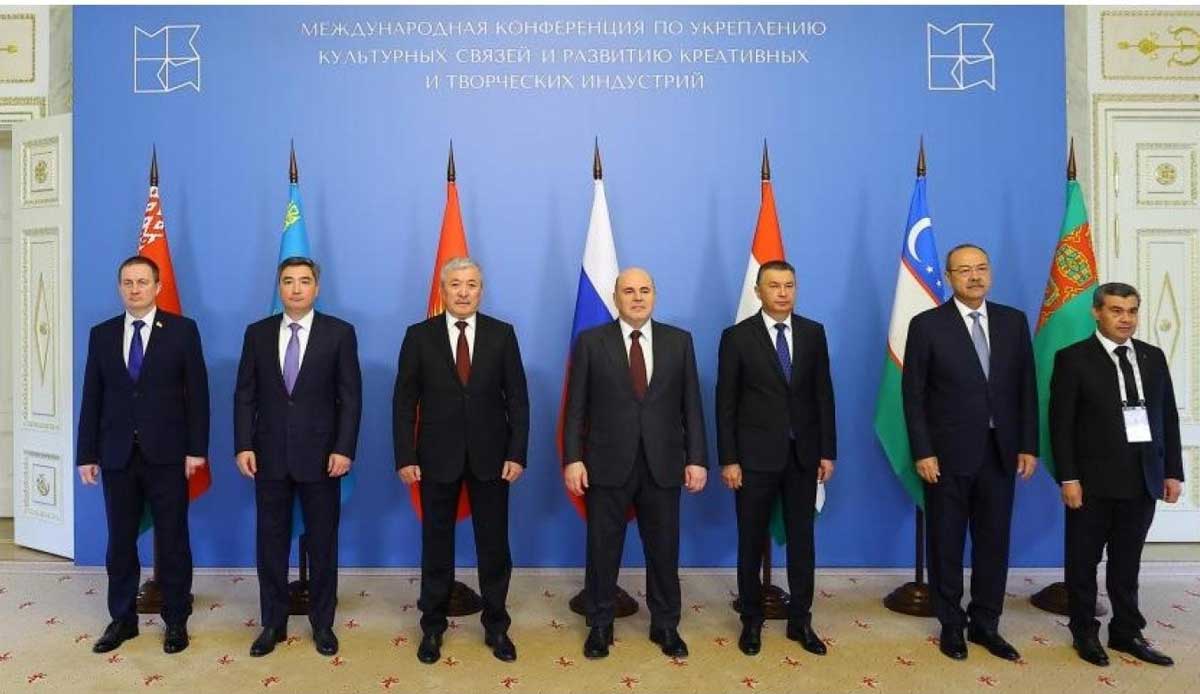
On June 18, 2026, an international conference on strengthening cultural relations and developing creative and artistic industries was held in St. Petersburg.
The conference was attended by a Turkmen delegation led by Minister of Education of Turkmenistan Jumamyrat Gurbangeldiyev.
During the international conference, speeches were made by Prime Minister of the Russian Federation Mikhail Mishustin, Prime Minister of the Republic of Belarus Aleksandr Turchin, Prime Minister of the Republic of Kazakhstan Olzhas Bektenov, Chairman of the Cabinet of Ministers of the Kyrgyz Republic – Head of the Administration of the President of the Kyrgyz Republic Adylbek Kasymaliyev, Prime Minister of the Republic of Tajikistan Kohir Rasulzoda, Prime Minister of the Republic of Uzbekistan Abdulla Aripov, as well as Minister of Education of Turkmenistan J.Gurbangeldiyev.
The conference was devoted to issues of strengthening cultural relations, preserving the common historical and cultural heritage, developing interstate humanitarian dialogue, as well as promoting creative and artistic industries as an important direction of modern international cooperation.
During the plenary session entitled “Intercultural Dialogue: Heritage Preservation and Global Dialogue in the Modern World,” participants discussed the current state and prospects for international cooperation. Particular attention was paid to preserving the common historical and cultural heritage, strengthening humanitarian relations, developing interstate dialogue, and developing modern tools for cooperation in a changing international situation.
A special place in the conference program was also occupied by a panel discussion entitled “Intercultural Dialogue: Traditions, Modern Meanings, and New Forms of Cooperation.” During the session, views were exchanged on current areas and prospects for cooperation in the fields of cinematography, theater, library and museum work, music and musical culture, and creative education.
In this regard, special attention was paid to preserving the common cultural heritage, strengthening professional and institutional relations, supporting joint projects, expanding cultural exchanges, and developing new forms of cooperation that meet the modern requirements of society.
In the panel discussion titled “Creative Industries on the Agenda of International Cooperation,” experts discussed ways to join efforts to create a single cultural and economic space, develop joint projects with high export potential, support creative initiatives, and disseminate successful experiences at the interstate level.
The importance of creative industries in preserving the cultural code of peoples in today’s digital world, the need to create new competitive cultural products by combining talents, traditions, and technologies, was also emphasized.
In his speech, the Minister of Education of Turkmenistan Jumamyrat Gurbangeldiyev noted that within the framework of Turkmenistan’s chairmanship of the CIS in 2026, special importance is attached to strengthening cultural and humanitarian cooperation, preserving historical and cultural heritage, developing interstate dialogue, and promoting modern forms of cooperation. It was noted that, based on the “open door” policy inherent in Turkmenistan and the legal status of permanent neutrality, the country’s culture is considered a “golden bridge” that unites peoples, strengthens trust, mutual understanding, and respect.
The participation of the Turkmen delegation in this international event clearly demonstrates our country’s consistent commitment to developing cultural and humanitarian cooperation, strengthening friendship and mutual understanding between peoples, as well as supporting joint initiatives in the CIS space.
In connection with Turkmenistan’s chairmanship of the CIS in 2026, special attention is paid to promoting humanitarian dialogue, preserving spiritual and cultural heritage, and developing education, science, culture and creative industries as important areas of long-term cooperation.
The Turkmen side confirmed its interest in further developing mutually beneficial cooperation, expanding cultural exchanges, supporting joint projects, as well as strengthening professional relations between cultural and educational institutions and creative communities of the participating countries.